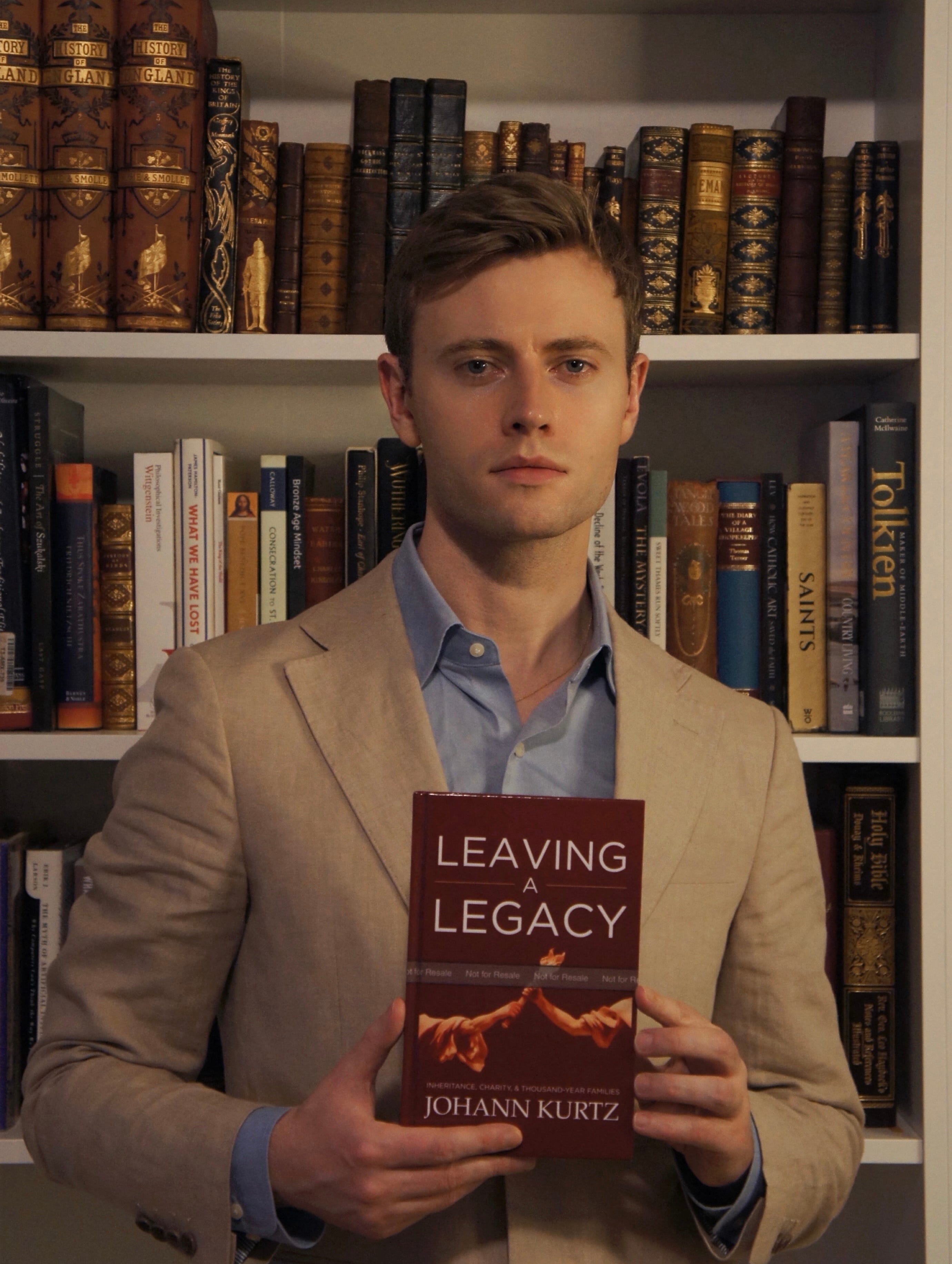
I speak with with the semi-pseudonymous Johann Kurtz on his terrific new book Leaving a Legacy: Inheritance, Charity, & Thousand-Year Families. Johann lays out the foundation for why it can be moral to leave an inheritance when pared with virtue. We talk how ‘Die with Zero’ misses the mark, why true charity is necessarily multi-generational, family business as a conduit for generational continuity, and what J.K. Rowling instinctively understands about the re-enchantment of the world.
Intro/Outro: Legends of the Fall Main Theme - James Horner
Disclaimer: All opinions expressed by Andrew Flattery and his guests are solely their own and do not reflect the opinions of Flattery Wealth Management, a registered investment advisor. This podcast is for informational and entertainment purposes only and should not be relied upon as investment, tax, or legal advice. Clients of Flattery Wealth Management may maintain positions in Bitcoin and the securities discussed in this podcast.
———
FULL TRANSCRIPT
Lightly edited for clarity.
THE GIVING PLEDGE AND THE CASE AGAINST DISINHERITANCE
Andrew Flattery: Johann Kurtz, thank you so much for joining. It’s great to chat with you. Congrats on the book—I’m on the John Hancock chapter right now. John Hancock wearing his finery.
Johann Kurtz: It’s wonderful to be here. Thank you very much for having me. Indeed—he’s quite something. You know, I’m an Englishman, so the only Americans I identify with I want to be aristocrats.
Andrew Flattery: It reminded me of Mark Zuckerberg, who used to talk about how he only wore the hoodie. I think that was kind of celebrated at the time. But one of the points you make in the book is that John Hancock—sure, maybe he was a bit of a dandy—but he was also setting an example. If he dresses well, maybe that encourages others to dress well too. And now you see people going to the grocery store in pajamas. I’m not blaming Mark Zuckerberg, but there it is.
Johann Kurtz: The Zuckerberg thing is unfortunate. One of the things I lay out in the book is a theory of sociology drawing from E. Digby Baltzell, this wonderful American sociologist who coined the term “WASP.” He was brought to my attention by Aaron Renn, the Christian social commentator. In Baltzell’s sociology, there’s this idea that first-generation elites—men like Zuckerberg, who are self-made wealth—necessarily have certain limitations in their cultural leadership because they typically have had technocratic or practical educations, like computer science at Harvard. There’s nothing wrong with that. But when those people become society’s only elites, you find the people setting the cultural and aesthetic tone are the same people who, approaching middle age, will wear the same t-shirt every day. Without the sense of dynasty and cultivation that comes from multi-generational families, you end up in a world of Zuckerbergs and Musks. I think you see this even more strongly in architecture—our elites today are not building beautiful buildings. My theory is that has a lot to do with the fact that contemporary America is dominated almost totally by first-generation wealth. That’s a sign of healthy social mobility, but it may also be a warning sign that we’ve forgotten how to build lasting, intergenerational things.
Andrew Flattery: It’s been about fifteen years since the Giving Pledge—Warren Buffett and Bill Gates committing to donating most of their wealth to philanthropy and encouraging others to do the same. I think now a lot of us are viewing this with more skepticism. You hear it all the time: Keith Richards is disinheriting his children. Jackie Chan said his son won’t inherit his fortune because “if he is capable, he can make his own money; if he is not, he will just waste my money.” And then the one in your book that sort of broke my heart was Shaq. Shaquille O’Neal said, “My kids are older now. They’re kind of upset with me. I tell them all the time: we ain’t rich. I am rich. I’m not giving you nothing.” So, Johann—playing devil’s advocate—what’s the problem? Maybe that’s just tough love. Why is this a bad thing?
Johann Kurtz: I gave Shaq a bit of a hard time in the book. That quote is actually part of a longer section where he says he’s not going to give his kids anything, but if they come to him with a professionally made business plan, he’d consider investing in their business. So he’s at least giving them the charity of attention. But others, like Jackie Chan—the thing about his statement is that there’s an unannounced third option. Jackie’s laid out: if he’s worthy, he’ll make his own money; if he’s unworthy, he’ll lose mine. But the missing option is: if he was worthy and received my money, he could go on to do greater things than starting from zero. That’s the case for the book—this lost third way. People don’t think it exists because of this contemporary conception that money necessarily corrupts. My hope is that the book lays out the theological, philosophical, and practical foundations—rooted in history and the stories of great men of the West—showing there is a repeatable path. Certain “thousand year families” have passed on not just wealth, but an inherent way of doing things which stewards children toward virtue, discipline, and resilience.
THE MISSING BILLIONAIRES AND THE EROSION OF DYNASTY
Johann Kurtz: There’s a striking statistic I cite from the book The Missing Billionaires, a risk management book by a couple of hedge fund managers. They note that if the thousand wealthiest families in America in 1900—starting at around five million and going up into the hundreds of millions—had invested sensibly, reproduced at the normal rate, and spent at a reasonable rate, each of those thousand households would have turned into roughly 16,000 billionaire households today, based on even conservative investment returns. And yet currently there are only about 700 billionaire families in the United States. With the incredible wealth creation of the 20th century, you’d expect far more. The fantastic opportunity for wealth creation wasn’t accompanied by a commensurate explosion of knowledge about the practices that old noble aristocratic families used to perpetuate their dynasties for centuries—or a millennium, in the case of the Grosvenors, the Dukes of Westminster. The current Duke inherited nine billion in trust at age 25, a fortune stretching back to 1066. My hope is that the book might make some small contribution to stabilizing that situation.
IS AMERICA READY FOR A BOOK ABOUT ARISTOCRACY?
Andrew Flattery: Americans like to cheer for success. We like rags-to-riches stories. There’s a strain of American identity that’s pro-egalitarian at the core. But personally, I think egalitarianism is kind of a fiction—it’s against reality. So why direct this book to an American audience? This seems like a more Eurocentric topic.
Johann Kurtz: Great question. Far be it from me to tell you about your own culture, but America’s history is great and diverse. It is now assumed that America was this egalitarian project, but I don’t think that’s really true. In Virginia before and after the Revolution, you had this cavalier aristocratic spirit. In Boston, you had Puritan ideals which were very hierarchical—leading families that eventually became the Boston Brahmins, the Cabots, the Adamses. There’s a real strain in America of multi-generational, successful, well-kept families with family businesses. I don’t think I’m imposing anything on America that isn’t well represented in the best of its history.
Johann Kurtz: As for why I focus on America: first, we all live in the global American empire now. You are the cultural centerpiece of the world. I’m a Christian, and I’m heartened at how strong that faith still lives in America compared to Britain. Second, the greatest wealth transfer in history—as the baby boomers near the end of their lives—is soon to happen. I’m hoping the book might have some small influence on families considering carefully how to structure their wealth and leave a legacy. It helps that my mother’s family are all American, so I’m something of an Americophile.
Andrew Flattery: There is a kinship between our countries. The women want to know what Princess Kate is wearing. We men want Prince Harry to pull it together. We watch all the PBS Masterpiece Theatre shows, the Downton Abbeys. But here’s the thing: there’s so much wealth in this country, and if wealth is not paired with virtue, that’s going to lead to disaster. And we’re already seeing it.
RE-ENCHANTMENT, CHRISTMAS, AND SACRAMENTALIZED REALITY
Andrew Flattery: Part of your larger project—evident on your Substack too—is what I’d call the re-enchantment of the world. Giving our children their history back, an identity, a cultural lore they can pass on. In the book, you make the case that Christmas is one of the areas of our culture that still has a bit of mystery, still carries the Christian ethos. You write: “Why does Christmas have such staying power? Why do so many attend church on this day when they have otherwise abandoned the faith? How does the magic live on? Christmas offers us a model of how the world should be and how we must make it again if we are to pass on our beliefs to our children. Every detail is harmonious and intentional. The world is sacramentalized and every aspect is imbued with meaning. Word is bound to action through ritual, and a reifying unity is produced.” I thought that was beautiful writing.
Johann Kurtz: Thank you. I think we have to be careful with the term “re-enchantment”—it’s overly flexible, as suggestive of magic as it is of what I’d call sacramentalized reality: noticing that everything around us is part of God’s creation, that the mechanics of the universe point back to a higher reality. You feel consoled, you feel like you are part of something living when the world around you is ordered to reflect that meaning, that transcendence. It’s difficult to re-enchant the world without living in an environment where particular aesthetics are cultivated, where old things are preserved, where we feel the generations who went before us as personal presences. That is intimately tied to this question of dynasty—building things meant to last, passing on a community, an estate, the artifacts of your parents before you.
Johann Kurtz: We live in a very disposable culture, and my contention is that has to do with a lack of ultra-long time horizon thinking. Christmas as a ritual is part of that—a ritual is something repeated through time, this beautiful thing you return to again and again as an assertion of continuity. Christmas is the canonical Western ritual. Everyone knows the elements: gathering around the tree, the giving of presents, going to Mass, the singing of sacred songs. It takes you out of the moment, back into this eternal time when you sing the same songs as your forefathers. When you step out into the cold, quiet air on Christmas night, that re-enchantment of the world does flicker for a second.
Andrew Flattery: There’s a tendency among the traditionally minded to say we need to go back to the halcyon days and figure out how Christianity was practiced centuries ago. But what’s beautiful about your approach is you’re saying: this is the world we live in right now. Christmas is still practiced and done very well. It’s been passed down to us. You’re not falling into the temptation of saying let’s go back a thousand years—you’re saying we can embrace what we’ve inherited and emphasize it.
Johann Kurtz: Quite so. There’s this concept in Catholicism called inculturation: when a civilization comes into contact with Christianity, the faith doesn’t call for the replacement of the organic culture—it calls for its perfection. Respecting the legitimate cultural patrimony while elevating it into the majesty of the Christian faith. You’ll hear pagans say, “Well, this festival is just a replacement of the pagan one before.” And to an extent that was often true—as a completely intentional decision. The coming of Christianity into a space was not supposed to be an act of dislocation but of perfection and transcendence. Something similar could happen to the contemporary West. There is a lot about the modern world that is eminently redeemable. I don’t think we’ll reinstitute the liturgical calendar of several hundred years ago—that’s rosy traditionalist thinking. Our task becomes: this is our cultural patrimony, for better or worse. How do we perfect it?
HARRY POTTER, HOGWARTS, AND THE ARISTOCRATIC IMAGINATION
Andrew Flattery: On that note—something that’s not going to score you a lot of trad points—J.K. Rowling kind of had this figured out. Every Harry Potter book had Christmas to the max. They really captured the vibe, the aura of Christmas.
Johann Kurtz: I understand the hesitation of religious figures who look at Harry Potter and see a world of witches and magic. But children can separate the fantastical elements from the deeper themes, and I believe Christian themes are inherent in the story. I wrote an article about this: if you look at the magic in Harry Potter, it’s not necromancy—summoning and controlling spirits. It’s incantation magic, where words you speak affect and change the world. It’s a reflection of how Christians conceive of prayer. There’s something biblical about “God spoke and the world was made,” and we participate in that through liturgy, through this act of speaking. My idea is that what Rowling’s doing is telling the spiritual history of Britain—that’s why it feels so English—and it ultimately comes to a totally Christian conclusion: Harry’s sacrifice of himself, this Christ-like reflection in the book’s finale.
Andrew Flattery: You turned me on to this internet subculture of people who are into Slytherin. I was appalled at first, but then I thought: has Slytherin been vindicated? They’re the defenders of tradition, holding up the ancient houses. The actor who played Draco Malfoy was one of the kids who didn’t betray J.K. Rowling. Maybe Slytherin house has been vindicated after all.
Johann Kurtz: This isn’t what I was expecting to talk about on this podcast, but I can talk about Harry Potter all day. J.K. Rowling was famously very poor and working class when she created this world, and it’s natural to have an organization representing the worst excesses of the aristocracy—that’s what she was trying to imbue in Slytherin. But as soon as you create a rich enough world, a true antagonist needs redeeming and realistic qualities. The strong sense of family, sense of place, old relics of family members—and Lucius Malfoy obviously has the best dress sense of anyone in the books, with that wonderful hair and cane.
Johann Kurtz: For me, the real star of the books is Hogwarts itself. It speaks to this deep fantasy we all have of being whisked away from our mundane Muggle existence into something older and more profound. This older story with generations of eccentric people who did wonderful and strange things. Living in a common room where a hundred generations have slept before us, sharing in their identity through the house system, wearing specific colors that demarcate our identities, living in a place filled with old stones warmed only by fire. It’s this yearning for a basically aristocratic world—a British boarding school that no longer quite exists.
Andrew Flattery: And despite everything, Harry’s history matters. He’s from his own legacy. It does matter who his parents were. Walk by any painting in Hogwarts and there’s a story, a history.
RAISING CHILDREN WORTHY OF EMPIRES
Andrew Flattery: A personal goal from reading your book is to try to elevate my family—make the next generation better than the last. But it strikes me that it’s a lot to ask of the nouveau riche—the Shaqs, the Jackie Chans—to essentially inculcate this virtue in their families and create these young nobles who can take the reins. Where do you start? What are some ways we can raise our children to take over an estate? Because if you give money to kids who aren’t virtuous, it’s going to be a disaster.
Johann Kurtz: I’m sympathetic to Jackie Chan’s position. From what I remember, he has something of a troubled son who probably couldn’t be trusted as a responsible steward of great wealth. One of the things I’m asking in the book is why that might be the case. Raising children in the context of great wealth is not like raising other children. It’s high stakes, high reward—this corrupting force is ever present.
Johann Kurtz: The book devotes three key chapters to this. The first, Raising Children Worthy of Empires, is about forming children with discipline and a sense of identity—subservience to higher things: the family, the community, and God. The next, A Thousand Year Estate, details how to configure the estate you leave them in ways that lend themselves to virtuous use rather than just liquid cash offering endless temptation. Finally, How They Take Power is about how you initiate children into the world of taking over the family business as a gradual process—not a light switch at the end of your life.
Johann Kurtz: The four elements of raising children in the context of wealth that I lay out in the book are: first, never forget the normal practices and rituals of raising healthy children. Second, ensure that your family has a strong faith and knows duties as well as privileges. Third, impress upon your children your family’s identity, mission, and values. And fourth, initiate children into structures beyond the atomic family.
DUTY OVER HEDONISM: THE CASE AGAINST DIE WITH ZERO
Andrew Flattery: The word “duty” is becoming a more operative term, and it’s directly opposed to Die With Zero. The title of that book is sort of a meme to me. What you’re saying in your thesis is: sure, we have certain privileges our success affords us. But there are certain duties that come with great wealth. What are those duties? Why do we have them?
Johann Kurtz: I have no compunction about picking on Die With Zero—it’s an immensely successful book, and Bill Perkins can weather the storm of our criticism. If I was to offer a defense: there is an element of useful truth in Perkins’s thesis. Most people have an unintentional relationship with wealth. They know they’re supposed to accrue and preserve it, but they don’t think far ahead about how to use it. Perkins encourages readers to model their wealth against life priorities and allocate enough time to achieve beautiful things. Don’t just work flat out until the end and die unfulfilled. There’s something important there.
Johann Kurtz: But his thesis is like the first step in getting out of Plato’s Cave. He says wealth is not an end unto itself—and he’s absolutely right. Wealth should be used to achieve real-world effects, to build real things. Where he falls short is that he never quite escapes this hedonist ethic. All his examples about how to spend wealth are quite trite—beach parties, boomer cruises and golf. It starts in the right direction but devolves quickly.
Johann Kurtz: The case I make is that societal inequality can be justified—and generational inequality can be justified—if elites accept their position of responsibility in the domains of spiritual leadership, taste, etiquette, aesthetics, and accountability for the health of their community. If everyone around them has to work hard all day on their technical field, it is reassuring to know that at a higher level, people who are part of what came to be known as the leisure class are thinking about these matters holistically. That sounds ludicrous today because our current elites have failed in that duty. But you still see it in small towns, in particular cities. There are billionaires and centimillionaires today who have taken real responsibility for their communities—patronized important institutions like the church, made their surroundings more beautiful and safe. Those people are the heroes of the book.
PERSONAL PHILANTHROPY VS. PHILANTHROPIC RACKETS
Andrew Flattery: You make the point that these people are doing it personally. They’re involved in philanthropy that’s not a racket, not financialized through multiple intermediaries. They feel a duty to their community and they’re personally invested. That’s the philanthropy we want—in your community, in your circles, where you can make an impact and be held accountable.
Johann Kurtz: Imagine a counterfactual where Microsoft was never taken public and remained a family business. When philanthropy is separated from this older, community-focused, personal-relationship-based vision of charity, it becomes unmoored. When you try to conduct charity along scientific lines in domains where science has relatively little purchase—the social sciences are famously much less productive than physics or chemical engineering—disaster can result.
Johann Kurtz: Bill Gates’s moral contention is that it was good to sell Microsoft to the public markets and use the resulting wealth for the Gates Foundation. But a family company could take long-term moral stances that a publicly traded company with fiduciary duties to maximize shareholder value cannot. A private company would face less pressure to offshore jobs. Henry Ford built a thriving business and a thriving city of Detroit in part due to his insistence on fair wages in the context of a perfectly profitable enterprise. Under market pressures, that defensibility is reduced.
Johann Kurtz: You can imagine a counterfactual where the Gates family remained in San Francisco, seeing themselves as its perpetual stewards. When you move from locally rooted charity to abstract philanthropy focused on things in Africa—the Gates family don’t live in Africa—they don’t focus on the local poor. So why live among them? They relocate to gated communities, and this is documented in Charles Murray’s Coming Apart as the increasing geographic isolation of the elite from everyone else. Places like San Francisco are left to rot.
Johann Kurtz: The Gates Foundation now wields political power comparable to major countries. There was a time when the top contributors to the World Health Organization were: number one, the United States; number two, the Gates Foundation; number three onwards, major countries. Any major global health decision had to pass through Bill Gates unofficially. That pattern has played out in education and other sectors. His vision of charity looks a lot like public governance—but he’s not an elected official, not accountable to public mechanisms of redress. He’s a shadow force, much like George Soros in international politics. That is a much less transparent, accountable, community-oriented vision. It has serious problems.
THE FORD FOUNDATION TRAGEDY
Andrew Flattery: Your section about Henry Ford actually gave me a sympathetic view of the Ford family that I didn’t have before. He was involved in establishing the Ford Foundation, but it took on a life of its own. After he realized what had happened, it was too late—he basically lost control. The lesson: don’t abdicate the throne. Figure out a way to maintain control in the family.
Johann Kurtz: It’s still one of the largest foundations in the world. If you wanted to extract a single central contention from the book, it’s this: true charity is a necessarily multi-generational project, and there needs to be a continuous line of stewards with the same values, the same spiritual foundation, to protect charitable investments. Otherwise, you get extreme short-termist philosophy.
Johann Kurtz: There was an Irish billionaire who committed to giving away all of his wealth within his lifetime. I actually think that’s a morally superior position to the Giving Pledge, where the signatories live as the richest and most powerful people in the world until death takes their riches—they’re not making a sacrifice during their own lifetimes. The problem this Irish billionaire had is that given his life expectancy and expected returns, he would have to give away many millions of dollars every day. That process necessarily implicates waste, confusion, and probably negative externalities. The Ford Foundation was described by one historian as “a large body of money surrounded by people who want some.” Those are the conditions you engender when you aggressively give money away outside the stewardship of a family with an ultra-long time horizon.
Johann Kurtz: The Ford Foundation is a multi-layered tragedy. It’s a tragedy that they were forced into it by extremely aggressive inheritance taxes. It’s a tragedy that Edsel and Henry Ford went to their deaths thinking they’d created an institution that would do tremendous good. And watching Henry Ford II openly lament the complete loss of control of the foundation in the seventies is one of the great tragic American stories.
ILLIQUID WEALTH, FAMILY BUSINESS, AND THE LONG VIEW
Andrew Flattery: What practical ideas do you have around actual financial wealth? How do you align your estate in a way that makes this advantageous for multi-generational legacy?
Johann Kurtz: One of the things I look at in the book is very counterintuitive by modern standards: a philosophy of inheritance where you try to pass on assets which are as illiquid as possible. This was both obvious and made more sense in the age of the aristocracy, when the majority of holdings were anchored in physical estates—landed estates, ornate houses filled with art and valuable objects, surrounded by productive land used for agricultural, commercial, and residential purposes. The beauty of this system is that when you pass wealth to your child, you’re passing on something that affords them a life of tremendous beauty but also demands active stewardship. These estates are challenging to manage, cultivate, and finance—and they come with an obligation of duty to everyone who derives a living from them.
Johann Kurtz: That’s perhaps more difficult in the contemporary age—farming is famously hard to generate income from at the ultra-high-net-worth level. So does the landed estate model still work? Probably not as it was practiced. But I think we can at least defend multi-generational family businesses. Much of the book is devoted to what form those businesses should take, and how to navigate the challenges: children who aren’t interested in taking over, or who seem incompetent. There are solutions you can implement later in life. But the real call of the book is to start raising children from birth—as the aristocracy always have—making clear what your expectations are, binding their identity into a greater family identity, so they want to take on the reins. Invest in the local community, beautify it, deepen relationships with local families, and you don’t end up with kids who just want to move to the city. You’ve created this jewel of a community—a warm, ritualized place to stay.
THE LEGACY OF THE BOOK ITSELF
Andrew Flattery: You just published a book, and it’s famously hard to make money in publishing. But it strikes me that there are multi-generational publishing legacies—Tolkien’s family still stewards that business, the James Bond legacy. Maybe someday generations of Kurtzes will be republishing your book in new formats for the next century.
Johann Kurtz: I appreciate your confidence in my little coffee table book. But it’s been worthwhile. We both follow a lot of blogs with brilliant ideas but no real mechanism for cementing them in our civilizational consciousness—a blog post is fairly ephemeral, difficult to gift, and there are so many flying around. My hope is that by distilling the best of my ideas over the years into a digestible and shareable document, it might have some staying power.
Andrew Flattery: There’s a movement here that you are in front of—maybe leading. I’ve been following you for a few years now, and I feel invested in your success. If you win with this, Johann, that’s a win for me. The book is excellent. Everyone needs to buy it. When you do signed copies, let me know—I’ll buy a bunch for my clients.
Johann Kurtz: Those are very kind words. I’d love to pick your brain off the show on the tactical realities of implementing some of those suggestions.
———
The book is Leaving a Legacy: Inheritance, Charity, and Thousand Year Families by Johann Kurtz, available on Amazon in ebook, paperback, and hardcover.
Gentleman Speculator is produced by Flattery Wealth Management.
-modified.png)
Andrew Flattery is a CERTIFIED FINANCIAL PLANNER™ and Principal of Flattery Wealth Management. He serves affluent families in Kansas City and nationwide. Flattery is the host of Gentleman Speculator, a podcast on legacy, investing, and the life well-lived. When he’s not helping individuals build wealth, you can catch him playing rec sports, writing children's books, and spending time with his wife and four children.


