"The best business to own is one that over an extended period can employ large amounts of incremental capital at very high rates of return." — Warren Buffett
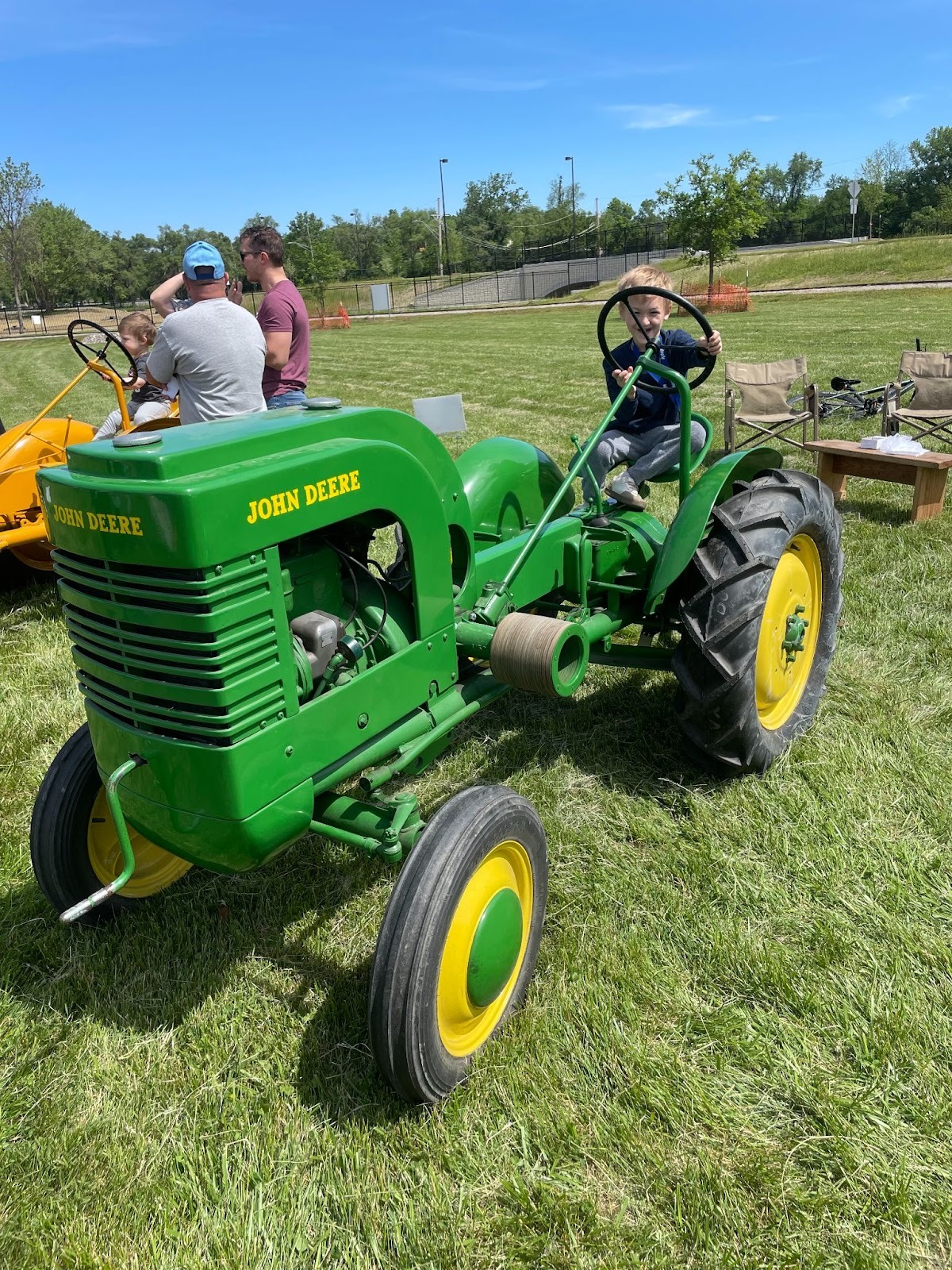
I remember riding with my grandpa on his International Harvester. Barn red paint on the body, white cab, and a stash of Oreos behind the seat. He must have had a certain allegiance to that brand, (although of course he was never so pretentious as to put it in those terms). But when I visit my uncle's operation today, everything is GREEN. Every piece of equipment in the machine shed. The caps on everyone’s head. John Deere won the war.
My son climbed onto a vintage Deere at a tractor show last summer. The thing was roughly 80 years old and the owner assured me it could still run.
I think about this when I look at Deere & Company (NYSE: DE) as an investment. The brand has survived nearly two centuries, outlasted numerous disruptions and sea changes, is now a leader in the next iteration of ag tech.
John Deere was founded in 1837 by a blacksmith/tinkerer in Grand Detour, Illinois, who figured out that a polished steel plow could cut through Midwestern prairie soil better than the cast iron versions farmers were breaking every season. That single insight, solving a real problem for a real customer, built what is now a $156 billion company. There's a tangent here on how two inventions more or less led to the settling and growth of Midwestern and Great Plains farming states: Deere's steel plow and barbed wire. But I digress.
Today, Deere operates across four segments: Production and Precision Agriculture (the big tractors and harvesters), Small Agriculture and Turf (think your neighbor's riding mower), Construction and Forestry, and Financial Services. They sell through over 2,000 dealer locations in North America alone, with reach into more than 100 countries. Revenue in the most recent quarter (Q1 FY2026) came in at $9.61 billion, well above consensus. The stock trades around $577 as of mid-March 2026.
But the bigger story is this: in 1900, roughly 40% of the American workforce farmed. Today it's under 2%. Fewer people farm more acres every year, and the operations that survive are larger, more capital-intensive, and more dependent on technology. Whether we romanticize the family farm or not, the modern world runs on commodity agriculture at scale. Someone has to build the machines that make that possible. Deere is that someone. Every wave of consolidation, every farm that goes from 500 acres to 5,000, every operation that replaces seasonal labor with GPS-guided autonomy, is a tailwind for the company that sells the equipment. The trend toward fewer, larger, more automated farms is not reversing. It has been accelerating for a century, and Deere has been on the right side of it the entire time.
This has touched my own family. The Flatterys have moved off the farm. Only a few are left in the business, and one cousin ended up at Deere itself, which may or may not be a coincidence. So part of me obviously values the family farm, what it represents, our ancestors making the effort to leave the land for the next generation’s stewardship. But the trend is the trend, and Deere is positioned on the right side of it.
First, the AI and autonomy story. At CES 2026 (e.g. the biggest tech trade show in the world), Deere brought the largest autonomous heavy machinery on the show floor. They now offer a Precision Upgrades kit that converts existing 8R and 9R tractors into autonomous machines a farmer can run from a smartphone. This is a 189-year-old manufacturer embedding software and recurring revenue into hardware it already dominates. The "smart iron" approach, where hardware becomes a gateway to subscription software and fleet management contracts, could smooth out the cyclicality that has always made ag equipment stocks bumpy.
Second, the brand. Farmers “pay more for green paint” because Deere has earned a reputation over generations for reliability, dealer support, and resale value. The leaping deer logo carries the kind of loyalty that consumer brands spend billions trying to manufacture. It is an intangible asset that does not show up on the balance sheet but shows up in pricing power, dealer density, and the fact that used Deere equipment holds its value better than almost any competitor.
Third, and this is the Chris Mayer 100 Baggers argument: sometimes the best multi-baggers are companies that have already 100x'd. One share of Deere purchased before September 1972 equals 24 shares today after four stock splits. At roughly $577 per share, that original investment has compounded into something north of a 500-bagger over five decades. The 20-year total return alone is over 2,000%. The instinct is to think the big gains are behind us. But that's what people said about Deere at $50, at $100, at $200. Companies with durable advantages, pricing power, and the ability to reinvest at high returns on capital tend to keep compounding.
Deere is cyclical. Management projects a 15-20% decline in large ag equipment sales in the U.S. and Canada this year. Tariffs are projected to cost the company $1.2 billion in fiscal 2026, though the tariff picture is changing all the time with recent legal developments potentially reducing some of that burden. The stock trades at roughly 33 times trailing earnings, not cheap for a cyclical manufacturer, even one with a growing software business. And competition from AGCO, CNH Industrial, and others in autonomous technology is intensifying. Deere has the lead in tech, but tech can be notoriously ripe for disruption.
Q1 FY2026 earnings were a blowout: $2.42 EPS versus $2.02 expected, with 18% growth across industrial businesses. Management raised full-year net income guidance to $4.5-5.0 billion. DA Davidson recently raised their price target to $775. The Tenna acquisition expands Deere's digital tools into construction fleet management. And Small Ag and Construction segments are each expected to grow roughly 15% this year, which could offset weakness in large ag.
While the urge to trade a cyclical stock is there, Deere is the kind of business you want to own for decades. Farmers like the products and are die hard loyalists to the brand. Just about anyone who studies the numbers can understand the compounding.
Nothing runs like a Deere. Including, maybe, the stock..?
Flattery Wealth Management, LLC is a registered investment advisor offering advisory services in the States of Missouri, Kansas, Iowa, and other jurisdictions where exempt from registration. This communication is provided for informational purposes only and should not be construed as investment advice. It does not constitute an offer, solicitation, or recommendation to buy or sell any specific security or instrument, nor does it endorse any particular investment strategy.
Charts and graphs are included for illustrative purposes only, and this communication should not be considered research. It does not express valuation judgments on any financial instrument, issuer, security, or sector mentioned and does not represent the official view of Flattery Wealth Management. It should not be assumed that Flattery Wealth Management will make future investment recommendations consistent with the views expressed herein or employ the described techniques in managing client accounts.
There is no assurance that any investment strategy or technique will be successful, and historical market trends are not reliable indicators of actual future market behavior. Recommended allocations are subject to change, and their effectiveness is not guaranteed. The investment strategies, techniques, or philosophies discussed may be unsuitable for certain investors based on their specific objectives and financial situation.
The following practices are used to calculate total returns: a) Cash and cash equivalents are included as part of portfolio assets; b) composite returns are size and time weighted using trade-date accounting, with portfolios being valued monthly; c) leverage is not commonly used as a strategy in managing client portfolios; d) investment results include the reinvestment of dividends and other earnings; e) for a complete discussion of the investment strategy used to obtain these results, please contact Flattery Wealth; and f) "S&P 500" is the return for Standard & Poors 500 index with dividends reinvested.
-modified.png)
Andrew Flattery is a CERTIFIED FINANCIAL PLANNER™ and Principal of Flattery Wealth Management. He serves affluent families in Kansas City and nationwide. Flattery is the host of Gentleman Speculator, a podcast on legacy, investing, and the life well-lived. When he’s not helping individuals build wealth, you can catch him playing rec sports, writing children's books, and spending time with his wife and four children.


